How Concert Programmes Changed From Notices to Keepsakes
Trace how concert programmes shifted from practical notices to personal keepsakes, and learn how to read an old copy without mistaking it for a full record.
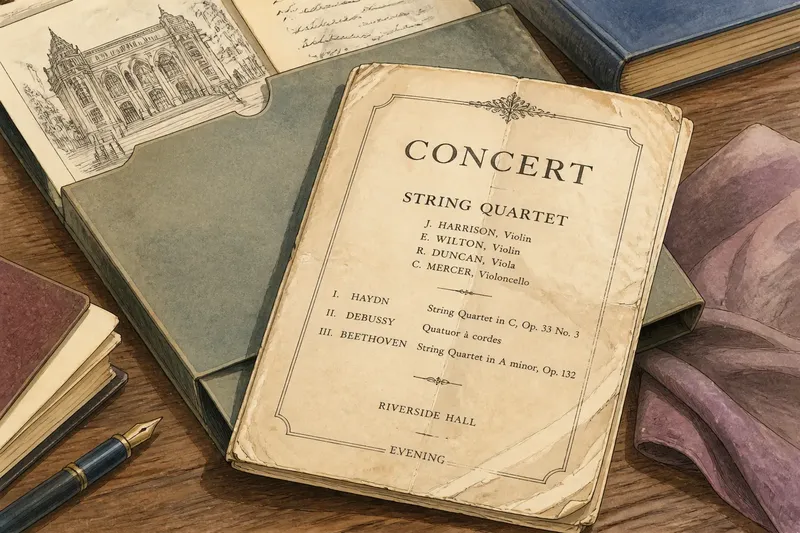
An old concert programme slips from a folder onto the table, its ink faded and its edges bent. That concert programme may tell you who was scheduled to perform and where, but its changing role is best understood as a broad shift in use—not a single, documented timeline. Printed concert materials could announce an event, identify its participants, and later serve as a keepsake for someone who attended.
Concert notices announced an event
A printed notice could tell a prospective audience that a performance was taking place and provide basic details such as names, works, time, or venue. The format varied with the event and its organizers; a notice was not necessarily a bound booklet or a complete account of what happened.
That distinction matters when reading an old sheet. Its wording can show what the organizers chose to announce. It does not, by itself, establish how the performance sounded, how the audience responded, or whether every listed item was played as planned.
Programmes gave listeners a reference during the event
As printed material became a familiar part of concert attendance, it could do more than announce a date. A sequence of works and performers’ names gave listeners a reference for the evening and a vocabulary for discussing it afterward.
Use depended on the person and the occasion. Someone might check the page before a piece, glance at it between works, or leave it alone once the music began. The printed information was available when useful; it did not need to compete with listening.
Explanatory notes added another layer
Some programmes included brief notes or biographical details alongside titles and names. That material offered an entry point for listeners who wanted context, while a simple list could be enough for someone who only wanted to identify a work.
Say you find an old programme that lists a string quartet and includes a short note about one composition. You can use the title and performers to identify the advertised event, then read the note as evidence of what context the programme offered. You still cannot infer from the page alone which passage moved the audience or how the musicians interpreted it.
What is not worth the effort is treating every printed note as a complete history of the performance. It records the information selected for the page, not the whole experience.
Format reflected the event and its audience
Concert printing took different forms. A programme might be a spare list, a handout with acknowledgments, or a booklet with performer information and notes. Those choices can suggest what organizers considered useful for a particular gathering, but they do not rank the event’s artistic or personal importance.
When examining a copy, look at what is actually present: the event title, names, venue, repertoire, notes, and any handwritten additions. Keep printed information separate from later annotations. That simple distinction helps prevent a guess or memory from being mistaken for something the page originally said.
Read an old concert programme without overstating its evidence
Can a programme confirm what was performed?
It can show what was announced or listed, but that is not the same as confirming what took place. Treat the printed sequence as a record of the plan unless another source or a clear annotation supports a stronger claim.
What can the design tell you?
Paper, layout, and the amount of printed detail can describe the object and the choices made for it. Avoid assigning a date or social meaning from appearance alone when the programme gives no supporting information.
How should you handle handwritten notes?
Record them as annotations, not as part of the printed programme. If you cannot identify who wrote a note or when, preserve that uncertainty rather than presenting an assumption as fact.
What should you write on a saved copy?
Add only information you can state plainly, such as a date or the name of a companion if you know it. If the detail is uncertain, mark it as a recollection or leave it out.
A small note can keep an archive useful
If you keep programmes, make the information easy to retrieve without turning every concert into a research project. Check each copy for identifying details, then add a brief note only where the page leaves a gap.
Check whether a date is printed; if it is, use it as the event date, and if it is absent, leave the date blank or mark any remembered date as uncertain.
Check for a venue name; if one is printed, record that wording, and if not, do not infer a venue from the paper or design.
Check whether performers are named; if they are, transcribe the names carefully, and if they are not, record that the copy does not identify them.
Check whether the repertoire is listed; if it is, label it as announced repertoire, and if the list is missing or incomplete, avoid calling it the full program.
Check for handwritten marks; if a note is legible and its author is known, preserve it with that context, and if either is unknown, describe it as an unidentified annotation.
Check whether you remember a personal detail; if you can state it confidently, add a short note about it, and if you are unsure, label it as recollection or omit it.
Imagine you have a programme with a venue and quartet names printed, but no date; a penciled title is readable, though you do not know who wrote it. You transcribe the venue and performers, record the title as listed repertoire, and leave the date blank. You describe the pencil mark as an unidentified annotation, then add that you remember attending with a friend only if that memory is clear. The result identifies what the page supports while keeping uncertain details separate.
Printed details and personal meaning remain different
A programme can document an advertised event and preserve the traces of its use. Its folds or marks may remind you of carrying it, but they cannot establish the sound of the room or the importance the evening had for someone else. A personal note can supply context, as long as it is clearly distinguished from the printed record.
The concert programme remains useful as a small archival object precisely because its limits are visible. Read what it says, label what you remember, and leave unsupported details unresolved; that practice makes the page easier to trust when you return to it later.