The Set-List Trap: Why a Song List Is Not the Whole Memory
A set list can anchor a concert memory, but a paired concert note also captures what caught your ear and gives you a more personal record to revisit.
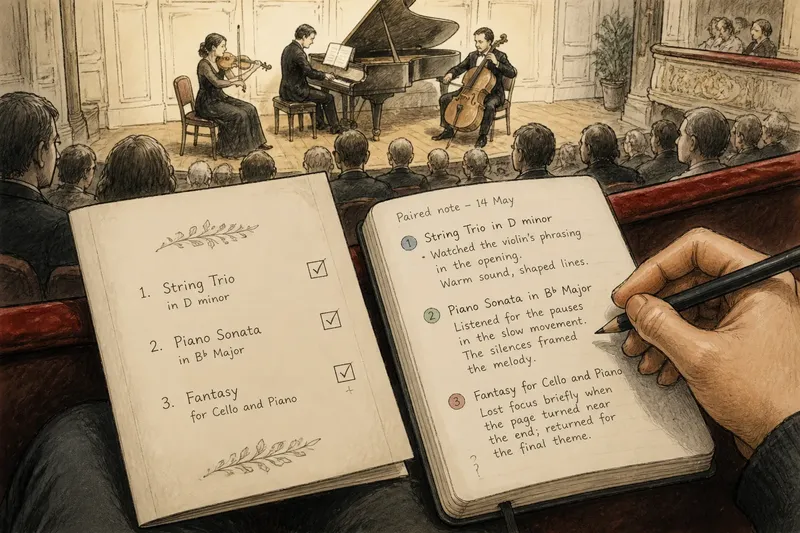
You open the folded concert program months later and recognize every title, but the evening itself stays hazy. A paired concert note links a few repertoire anchors with what you noticed while listening, so the record holds more than a sequence of names.
A song list is useful for remembering titles and order. The useful question is what you want the record to help you recover: the music performed, your own listening, or both. Choose a format that serves that purpose without turning the concert into paperwork.
A set list preserves the concert’s sequence
Writing down the works, songs, or movements gives your memory a clear frame. Names can be hard to retrieve later, especially when a program has several sections or the performer changes the announced order. A list helps identify what was played and gives you a reliable cue if you want to find a recording or revisit the program.
This approach suits listeners who care most about repertoire, attend unfamiliar music, or want to keep a record of what they heard. If the program already lists the works, a simple mark beside a title may be enough to show that it was performed or caught your attention.
A sequence does not record your response. It cannot show that a quiet passage drew your focus to the bass line, or that an interruption briefly pulled you away. Nor does it tell you which moment you would want to hear again. If you only need a repertoire record, that may be fine; if you want a personal account, add a detail that belongs to your listening.
Keep uncertainty visible. If you are unsure whether a title was announced or whether the order changed, add a question mark rather than silently guessing. An honest gap is easier to interpret later than a confident-looking mistake.
Attention notes record what you followed
An attention note describes a change in what you listened for or noticed. You might write that you began following the cello’s low line, watched a pianist’s hands during a difficult passage, or heard the audience settle after a late arrival. These details describe your experience without turning it into a verdict on the performance.
This format suits listeners who recall sensations more readily than titles, or who want a personal record rather than a complete catalog. For unfamiliar music, “I started listening for the repeated low notes” may be more useful than an uncertain attempt to name every section.
Attention notes can lose their context if they contain no musical anchor. A sentence such as “the room went still” may be vivid but hard to connect with a particular work months later. Pair it with a title, a program mark, or another cue when identification matters.
Use specific observations rather than language that could apply to any concert. “I watched the cellist’s bow during the slow passage” gives you something concrete to recall. “The performance was profound” may express a real feeling, but it offers little help in locating what prompted it.
A paired note connects repertoire with listening
A paired note combines a few titles or sections with a short account of what you noticed. It keeps enough sequence to identify the music while preserving a detail about how you listened. Select only the moments that feel useful; the aim is not to create a complete review.
This format suits listeners who want both a repertoire record and a personal account. It also works when the program matters, but a bare list would feel too thin. Use a pencil in the program if that is allowed, a removable tab if you want to keep the page clean, or a separate card or notes app.
Imagine you attend a chamber concert with three unfamiliar works and leave with the program. These details are invented for illustration: you notice the violin during the first work, listen for pauses in the piano during the second, and lose focus briefly when a page turns near the end of the third. You mark the three program titles, then add one short note beside each observation. The resulting record identifies the sequence and shows how your attention moved, while leaving room for what you did not remember.
Follow the program’s spelling and order when you can. If a title or sequence is uncertain, mark it as uncertain. Choose the format you can read later without taking your attention away from the performance.
Choose a concert note by the memory you want back
Before writing, decide what you want to recover when you revisit the event. If the repertoire matters most, keep a set list. If your own listening matters more, write an attention note. If you want both, make a paired note with a few titles and specific observations.
- Check your main purpose: If you want to identify the works, keep a set list; if you want to recall your response, add an attention note instead.
- Check whether the program names each work: If it does, mark the relevant titles; if it does not, write down an announced title or a performer cue you can identify.
- Check whether the order is clear: If it matches what you heard, follow it; if the performer changed the order, mark the sequence as uncertain rather than copying it as fact.
- Check whether you can write without distraction: If taking notes during a piece pulls you away, remember one detail and write it afterward; if it does not, make a brief mark only when venue rules allow.
- Check whether the impression has a musical anchor: If you can connect it to a title or section, place them together; if not, label the cue you do remember, such as the instrument or moment in the program.
- Check whether the note states an observation or a verdict: If it describes what you heard or followed, keep it; if it only says the performance was wonderful, add the specific moment behind that reaction.
It is not worth the effort to reconstruct every transition, audience sound, or reaction just to make the account look complete. A few accurate details are easier to use than a crowded page of guesses. You can leave a gap where your memory is blank.
Questions about choosing a concert note?
Should I write down every piece in the program?
Do that if a complete repertoire record is your goal. Otherwise, mark the titles tied to moments you remember and let the program preserve the rest.
What should I record if I do not know the music?
Write what caught your ear, what you began following, or when your attention returned. Add a program heading or performer name if you can identify one.
When should I write a note?
Write during the performance only if it does not distract you and the venue permits it. Otherwise, hold one clear observation in mind and record it afterward.
How can I keep an impression from becoming a review?
Use first-person observations rather than broad judgments. “I stopped tracking the beat and listened to the breath before the next phrase” describes your experience without claiming to judge the performance for everyone.
Use the set list as an anchor, not the whole record
A program or set list can restore names and order, but it cannot show what held your attention. A paired concert note gives you both: a few reliable musical anchors and a specific account of how you listened. When you revisit it, that combination can help you locate the music and remember what made the evening distinct to you.